

….But I’m Not At All Anymore
When my son was a toddler, I was already thinking about kindergarten. (Realtor problem: you plan four moves ahead, even for a three-year-old’s first day of school.) As any good parent does (or so I thought), I googled and googled until I found Toronto’s Fraser Institute school rankings, the annual report card that scores Ontario elementary schools out of 10 based on EQAO reading, writing and math results. Bingo! My cheat sheet to making sure either I or my ex-husband (his father) had an address inside the boundaries of one of the top ones. Because top equals good, right?
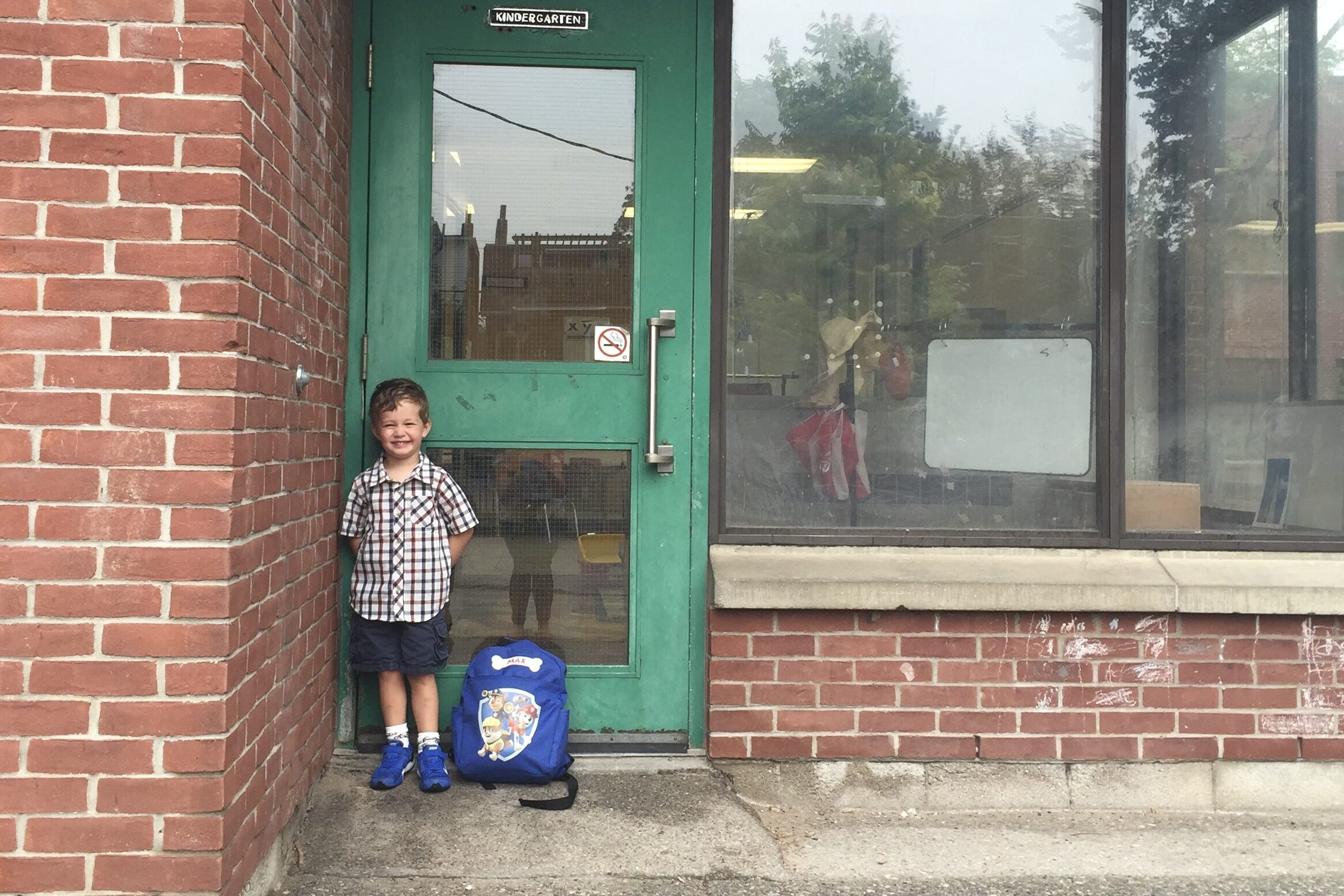
And so that’s where it started. Max went to a TDSB top-rated JK, then another top-rated SK through grade 6, in French immersion.
What That Actually Got Us
We got a couple of genuinely great teachers over at our top-rated primary school (JK-6) through the years. Big shoutout to Monsieur Steve and the best phys-ed teacher of all time, Mr. T. But what that top-rated school district also dealt us: provincial funding cuts, chronic teacher and educational assistant shortages, rotating supply teachers who never stuck around long enough to actually know the kids, bullying that an unresponsive administration didn’t manage well, and classrooms older than my boomer parents with no air conditioning.
Meanwhile, many friends of mine had kids at nearby schools with drastically lower Fraser Institute ranking scores. I got to know one myself, volunteering for its breakfast program. The teachers there? Excellent. Parents raved. Nothing about our top-ranked experience sounded better than theirs. If anything, it sounded a little more human.
Then He Got A Say
By middle school, as a two-home-divorced-parent kid, he had two school districts to choose between. He picked the one with the low Fraser Institute rating. Why? He liked the principal. He liked that the school was small. I was worried it would mean more of the same, bad teaching and bullies, but go figure, he thrived there. His teacher for both years, a Francophone from Paris, was outstanding: inspiring, strict, and someone who commanded real respect. The friends he made came from all walks, some families with less than us, some with more. They were wholesome kids, and I loved him being in their and their parent’s company.
By high school, he had even more of a say, and he picked the next low-rated school too: 5.5 out of 10. I heard there were drugs there. I also heard there were drugs at the high-rated school. Spoiler: there are, at both. My kid just hasn’t gone near them. He’s pulling 98s and 99s in math and science, took up the drums because of the school’s phenomenal music teacher, and can’t wait to go back this year.
At some point you have to admit the pattern isn’t a fluke.
So What Does A Low Score Actually Mean?
Here’s something I heard once from a guy I dated, who was a TDSB principal at the time. He told me the board would sometimes intentionally place its strongest teachers in the lowest-rated schools, the ones that needed them most. I can’t verify that as official, board-wide policy, so take it as one insider’s word, not gospel. But it tracked with everything I kept seeing.
What I can say with more confidence: a school’s Fraser Institute score leans heavily on EQAO test results, and EQAO results correlate strongly with things that have nothing to do with teaching quality: household income, how many students are learning English as a second language, how many families opt their kids out of the test altogether. Critics of the ranking system, including school boards themselves, have made this point for years. A 9/10 school and a 4/10 school can have equally dedicated teachers and wildly different report cards, simply because of who walks through the door.
What Your Kid Actually Gains At The “Lower-Rated” School
Kids in a lower-rated school learn something a top-ranked school with three enrichment programs and a violin room doesn’t always teach: that not every friend has the newest gaming console, or goes on a family trip to Europe every March break. And that’s completely fine. They learn empathy. They learn what community looks like when it isn’t curated. They learn about culture, diversity and inclusion. And from what I’ve seen, they still get taught to read, write and do math just fine.
The Real Estate Angle (You Knew This Was Coming)
Here’s the part that should matter to you as a homebuyer, not just a parent: in Toronto, a school boundary line can flip a house’s value by $100,000 to $400,000. Not because of square footage. Not because of the kitchen. Because of which side of an invisible line the address falls on.
You see it in Riverdale and Leslieville. You also see it in Roncesvalles and Parkdale. Nearly identical housing stock, two streets apart, and a meaningfully different price tag, because one feeds into the “top” school.
This means that the secret to buying a better house for less money in this city might be exactly what I’m telling you above: stop chasing the highest rating.
If I Were Doing It All Over Again
If I were a parent with a child approaching JK again, I wouldn’t start with a ranking site. I’d start with a Thursday night. I’d go visit the East Lynn Park Farmers’ Market in East York, find the young families having an al fresco dinner on the grass by the playground, and just ask them: what do you think of the school? Word of mouth tells you things a spreadsheet never will. Ask around long enough in this city and you’ll hear the same thing about certain low-scoring schools: that the families who actually send their kids there love them.
Sussex Avenue JPS in the Annex (3.3/10). Clairlea PS in Scarborough (4.1/10). Leslieville PS right in Leslieville (5.9/10). Bowmore PS in the Upper Beaches (4.7/10). Not one of them would crack anyone’s “top school” list. All of them have parents who wouldn’t trade them for a 9.
Have a good one to add to that list? Drop it in the comments on my socials or send me a DM. I’d love to keep growing it.
I’d look for the neighbourhood full of strollers and scooters on a weekday afternoon before I looked at a single score.
Quick Answers For Your 2AM Googling
Does a school’s ranking affect home values in Toronto? Yes, often significantly. Being inside a sought-after school boundary can add tens to hundreds of thousands of dollars to a home’s price versus a nearly identical house one street over in a different catchment.
What is a good Fraser Institute score for an Ontario school? Scores run 0 to 10, based on EQAO grade 3 and grade 6 reading, writing and math results. The provincial average sits around 6. A lower score often reflects the socioeconomic makeup of a school’s students as much as the quality of its teaching.
Should I buy a house based on school catchment? It’s worth knowing your boundary before you buy, especially in Toronto, where catchments are strictly enforced. But don’t let a ranking alone decide the neighbourhood. Talk to parents on the ground first.
The Bottom Line
A number out of 10 tells you how a school’s students performed on two standardized tests. It won’t tell you if your kid will get a Monsieur Steve. It won’t tell you if the principal will know their name. And it definitely won’t tell you whether they’ll thrive.
If you’re house-hunting with school catchments in mind, or wondering whether that boundary line is actually worth the premium, that’s a conversation I have with clients all the time. Give me a call, or send me a DM. 416-888-1844
#torontoschools #Torontoschoolrankings #buyingrealestateinToronto #torontorealtor